Artificial intelligence is becoming part of everyday life. Children already interact with AI through games, search engines, apps, and smart devices. Through the blog you will get the answer to this Should Children Learn Artificial Intelligence?
So, should children learn artificial intelligence? Increasingly, AI education can help children understand the technology shaping their world.
However, children do not need advanced programming skills to begin. Instead, they need age-appropriate activities that make AI concepts understandable and practical.
Through AI for kids, children can explore technology while developing creativity, curiosity, problem-solving, and critical thinking skills.
Why Should Children Learn Artificial Intelligence?
AI literacy can help children understand how modern technology works. It can also encourage them to become creators rather than passive technology users.
Furthermore, AI education for kids can introduce important future skills through practical projects.
Children can learn how computers recognize patterns, process information, generate content, and make predictions.
More importantly, learning AI should involve responsible technology use. Children should understand that AI can make mistakes and produce unreliable information.

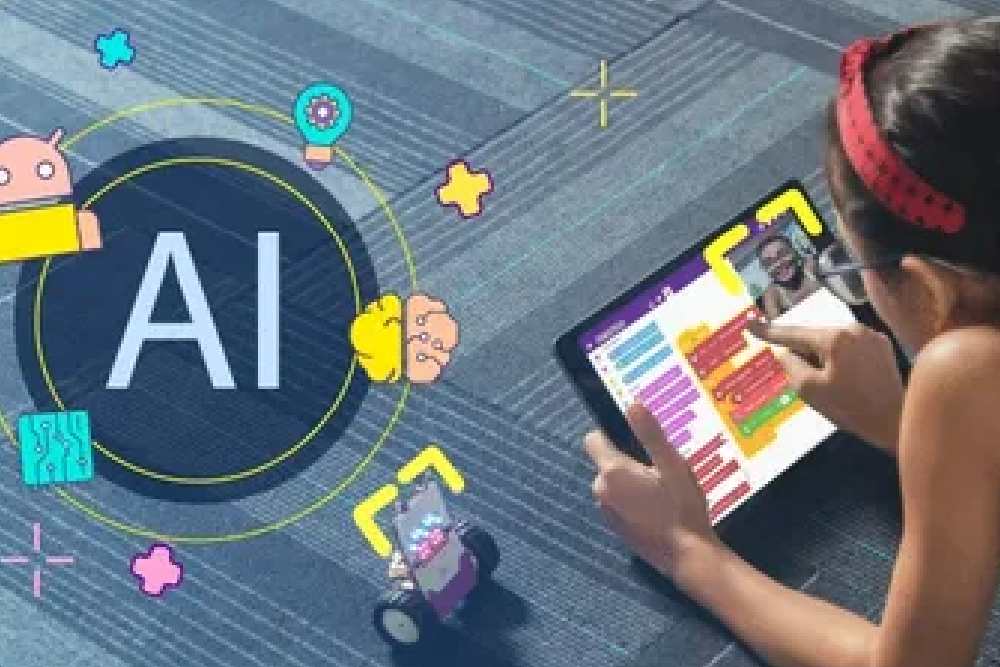

Understanding AI Through Simple Examples
Children encounter artificial intelligence in many familiar places.
For example, recommendation systems suggest videos based on previous activity. Voice assistants can recognize spoken commands.
Similarly, image recognition can identify objects within photographs.
These examples make artificial intelligence for children easier to understand. Teachers can connect new concepts to technologies children already use.
What Is Artificial Intelligence for Kids?
Artificial intelligence refers to computer systems designed to perform tasks that normally require human intelligence.
These tasks can include recognizing patterns, understanding language, making predictions, and generating content.
For children, the subject should remain practical and age appropriate.
Kids learning artificial intelligence can begin with simple experiments rather than complex mathematical models.
For example, children can explore how an AI system categorizes images. They can also experiment with simple chatbots or machine-learning activities.
The goal is not to make every child an AI engineer. Instead, the goal is to build technological understanding.
Benefits of Teaching AI to Children
There are several potential benefits of introducing AI concepts during childhood.
- Encourages curiosity about technology
- Develops logical thinking
- Supports creative experimentation
- Introduces computational thinking
- Encourages responsible technology use
- Builds confidence with emerging technologies
- Connects coding with real-world applications
Moreover, benefits of AI for children extend beyond technical knowledge.
When children create projects, they often need to test ideas, identify mistakes, and improve their solutions.
Developing Creativity Through AI Projects
AI projects can give children new ways to express ideas.
For example, children can create simple interactive stories, experiment with AI-generated images, or design basic educational applications.
However, children should remain actively involved in the creative process.
AI should support their ideas rather than replace their imagination.
This approach helps children understand that technology works best when combined with human creativity.
How AI Can Improve Problem-Solving Skills
Problem-solving remains an important skill regardless of technological changes.
AI activities can encourage children to break complicated problems into smaller steps.
For instance, students might design a simple system that identifies different types of objects.
They must decide what information the system needs and how it should classify the objects.
Consequently, children learn to think systematically.
Building Problem-Solving and Critical Thinking Skills
AI education can also encourage children to question technology.
They can ask:
- Where did the AI get its information?
- Could the information be incorrect?
- Why did the system produce that result?
- What information does the system need?
- How could the result be improved?
These questions develop critical thinking.
Therefore, teaching AI to children should include both technical exploration and thoughtful discussion.
What AI Skills Should Children Learn?
Children do not need to master every AI concept immediately.
Instead, they can gradually develop foundational AI skills for kids.
Important areas include:
- Understanding basic AI concepts
- Learning how algorithms work
- Exploring patterns and data
- Developing computational thinking
- Practicing coding
- Understanding machine learning basics
- Evaluating AI-generated information
- Learning responsible AI use
These skills can develop progressively as children become older and more experienced.
Learning About Machine Learning and Automation
Machine learning allows computers to identify patterns from data.
Children can explore this idea through simple classification activities.
For example, they could train a basic system to distinguish between different categories of objects.
Automation provides another useful example.
Children can learn how computers perform repetitive tasks according to programmed instructions.
These activities make complex concepts easier to understand.
Is Artificial Intelligence Safe for Children to Learn?
AI can be introduced safely when children receive appropriate guidance.
Parents and educators should select age-appropriate tools and activities.
They should also teach children not to share private information with AI systems.
Children should understand that AI-generated answers are not always accurate.
Using AI Tools Responsibly and Safely
Responsible AI education should include several important habits.
Children should protect personal information and avoid sharing passwords.
They should also question information produced by AI.
Furthermore, they should understand that AI-generated content may contain errors or misleading information.
Educators can also discuss copyright, originality, digital citizenship, and respectful technology use.
These lessons help children become responsible technology users.
How Can Parents Introduce AI to Kids?
Parents can introduce AI without making the subject complicated.
Start with technologies children already understand.
For example, discuss recommendation systems, voice assistants, translation tools, or smart search features.
Next, introduce simple projects.
Parents can also explore artificial intelligence classes for kids that provide structured activities.
Age-Appropriate AI Activities for Children
Different activities can suit different learning stages.
Younger children can explore patterns, sorting, logic games, and simple technology experiments.
Older children can explore coding, datasets, machine learning, robotics, and AI-powered projects.
Practical activities can include:
- Creating simple chatbots
- Training basic classification models
- Building coding projects
- Exploring robotics
- Designing AI-assisted stories
- Studying how recommendation systems work
The key is to make learning interactive and enjoyable.
How Coding Helps Children Understand AI
Coding provides an important foundation for understanding artificial intelligence.
Through programming, children learn instructions, logic, variables, conditions, and problem-solving.
For example, a child might create a program that responds differently based on user input.
Later, that understanding can support more advanced AI concepts.
Therefore, coding and AI education can complement each other.
Children can begin with visual programming before progressing toward languages such as Python.
Preparing Kids for an AI-Powered Future
The future workplace will continue changing as technology develops.
Children therefore need adaptable skills rather than knowledge of one specific tool.
AI education can help them understand emerging technologies while strengthening creativity and analytical thinking.
However, human skills will remain important.
Communication, teamwork, curiosity, creativity, and ethical judgment can complement technical knowledge.
The Future of AI Education for Children
AI education is likely to become increasingly integrated into technology learning.
Schools and coding programs can introduce AI through practical projects rather than purely theoretical lessons.
At the same time, educators need to consider privacy, accuracy, safety, and responsible technology use.
The most useful approach combines technical skills with digital literacy.
Preparing Kids for an AI-Powered Future
Children who understand AI can approach new technologies with greater awareness.
They can learn how systems work, identify limitations, and explore opportunities responsibly.
Most importantly, AI education should encourage children to ask questions and create solutions.
For parents searching for AI for kids, coding classes can provide a structured starting point.
At Techkids, children can explore coding and technology through practical, engaging learning experiences.
Ready to introduce your child to future technology skills? Contact Techkids on 0769607600 to learn more about available technology programs.
Frequently Asked Questions About AI for Kids
1. Should children learn artificial intelligence?
Yes, children can learn age-appropriate AI concepts through guided activities. Early exposure can build technology awareness and critical-thinking skills.
2. What is the best age to start learning AI?
There is no single starting age for every child. Younger children can explore patterns and logic, while older students can study coding and machine learning.
3. Is AI difficult for children to learn?
AI can become approachable when teachers use simple examples and practical projects. Children can gradually progress from basic concepts to advanced topics.
4. What are the benefits of AI education for kids?
AI education can develop problem-solving, creativity, computational thinking, and digital literacy. It can also help children understand emerging technologies.
5. How can parents teach AI to children at home?
Parents can begin with everyday AI examples. They can then introduce supervised coding activities, educational AI tools, and age-appropriate technology projects.
6. Can coding help children learn artificial intelligence?
Yes. Coding teaches logical thinking and computational concepts that support later AI learning. Visual programming can provide an accessible starting point for younger learners.
Conclusion
So, should children learn artificial intelligence? Age-appropriate AI education can give children valuable knowledge about the technology surrounding them.
More importantly, effective AI learning goes beyond using AI tools.
Children should learn how AI works, question its results, protect their information, and use technology responsibly.
With coding, creative projects, and guided experimentation, children can develop skills that support lifelong learning.
The goal is simple: help children understand technology while giving them the confidence to create with it.